
By Coach Adam Walker, The Cycling Co
We’re into March, and if you’re racing BC Bike Race this year, this is a critical transition phase in your training.
It’s time to move from the trainer to the trail.
You’ve spent months building aerobic fitness, stacking base miles, and putting in solid gym work. Now, with longer daylight hours and improving weather, it’s time to transfer that indoor fitness to real-world performance.
And that transition? It needs to be intentional.
Trainer vs. Trail: Understanding the Performance Spectrum
When you’re indoors on the trainer, everything is controlled:
• You control the wattage
• You control your heart rate
• You control temperature
• You control resistance
Out on the trail? It’s chaos.
You can’t control terrain, traction, line choice, weather, or what’s coming around the next corner.
And here’s the key: BC Bike Race happens in the real world, not on your trainer. So we need to bridge that gap.
I like to think of it as a spectrum:
• One end: Controlled trainer efforts
• Other end: Technical, unpredictable trail riding
Most athletes are stronger on one end of that spectrum.
Where do you sit?
• Pure mountain bikers: Years of singletrack experience, strong technically, but maybe lacking steady climbing power on long gravel roads.
• Road or gravel athletes: Strong FTP and sustained power, but struggle to transfer that power efficiently on technical terrain.
• Trainer-focused athletes: Dialed in physiologically, but lacking real-world trail application.
The biggest gains usually lie on the side you’re resisting. That’s true in training and in life.
How to Transition Fitness from Indoor to Outdoor Riding
Get Outside Deliberately
If you’re strong technically but lack sustained power:
• Do tempo or threshold intervals on gravel or road climbs.
• Practice steady power output on longer sustained efforts.
If you’re strong on the road but less confident technically:
• Ride more singletrack.
• Do intervals in real trail environments.
• Learn to apply power through corners and technical features.
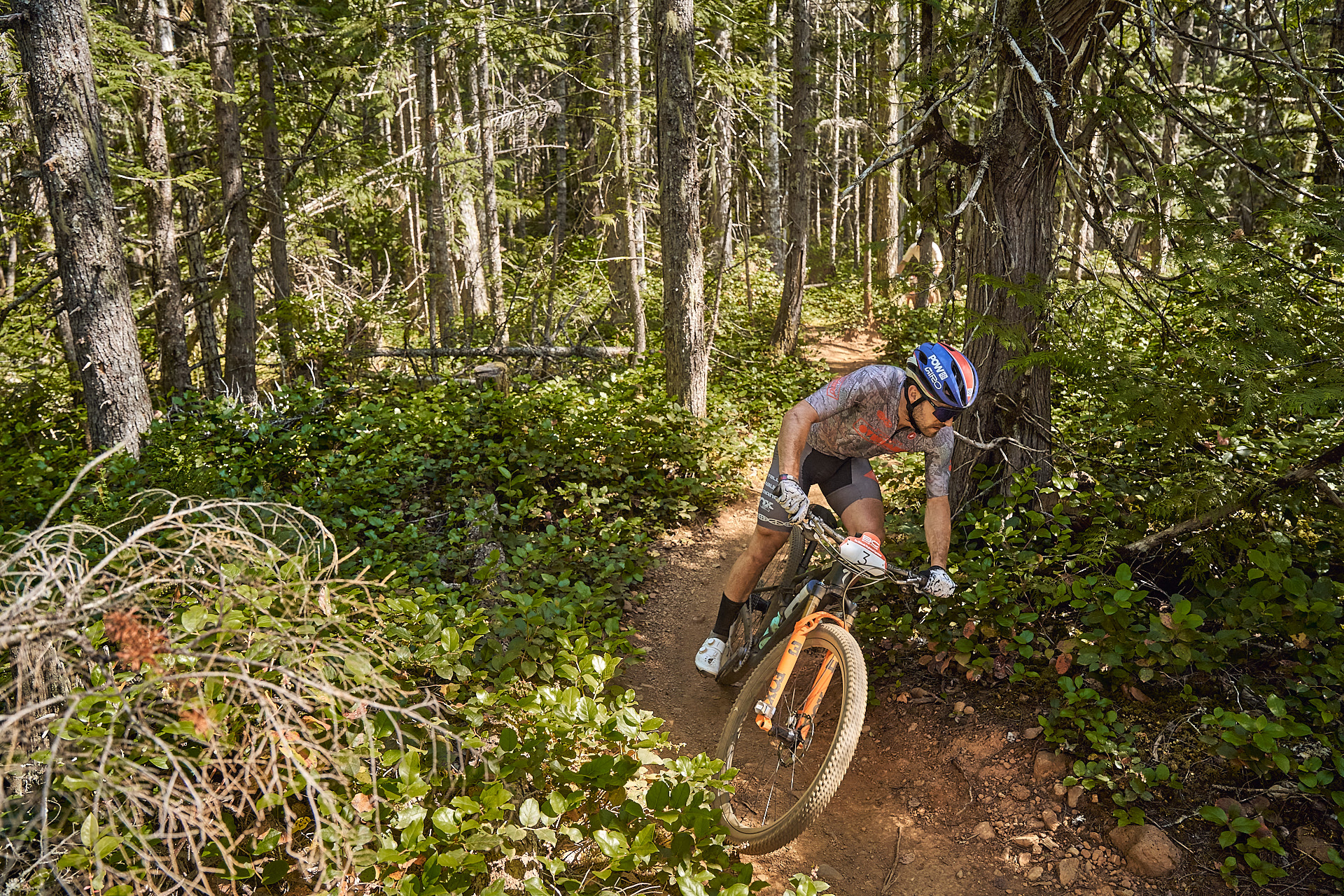
Simply riding your mountain bike outside, regularly, is one of the most important steps as BCBR approaches. Skill comes from exposure and deliberate, focused work.
Combine Fitness and Skill Development
One of my favorite ways to train this time of year is to combine structured intervals with skill practice.
Here’s an example workout:
Threshold + Descent Skills Workout
• 4 minutes climbing at threshold
• 1 minute descending with focus on:
– Body position
– Mobility
– Braking control
– Cornering
• 1 minute recovery
Repeat
This works for:
• XC racers
• Gravel racers
• Enduro athletes
• And especially BC Bike Race riders
You’re building power on the climb and sharpening technical skills on the descent all in one session. You’ll also improve:
• Terrain awareness
• Line selection
• Direction control
• Efficiency on the bike
That’s a big step to becoming a more complete rider.
Rebuild Fundamental MTB Skills
You tuned the “engine” all winter. Now it’s time to tune the “suspension and transmission”, meaning your technical efficiency.
Start incorporating:
• Wheel lifts
• Bunny hops
• Manuals
• Wheelies
• Slow-speed balance drills
These small skills compound over a multi-day stage race like BC Bike Race. Efficiency equals energy savings. And energy savings equal speed over seven days.
Be Smart with Terrain for Endurance Work
Zone 2 endurance rides are critical right now, but terrain matters. If you’re riding super punchy trails, your heart rate and power will spike constantly. That makes it hard to stay in true endurance zones.
Better options include:
• Longer, gentler gravel climbs
• Controlled loop terrain
• Road or gravel bikes for steady-state rides
Yes, you can do Zone 2 on a mountain bike, but you need to be smart about terrain selection.
Remember: Your body adapts specifically to the stress you apply.
Avoid the Zone 3 Trap
This is a big one. The Zone 3 trap looks like this:
• 90 minutes available
• Leave the parking lot
• On the gas the entire time
Every ride feels “kind of hard.” You’ll get fit, but only for a while. Then you plateau.
To maximize adaptation:
• Much of your time on the bike should be relatively easy.
• Hard rides should be intentional and structured.
• Polarize your training.
That means:
• True endurance rides at low intensity
• Focused threshold sessions
• Dedicated VO2 max work
• Plenty of recovery
Structure now sets up performance later.
Don’t Jump Straight to Race Simulations
With BC Bike Race about 12 weeks away, it might be tempting to start doing 4–5 hour mountain bike rides, back-to-back days, “empty the tank” sessions.
Those big durability rides will come. But they only work if you’ve already built:
• Aerobic base
• Threshold power
• High-end VO2 capacity
• Efficiency in each system individually
Right now, we train the pieces. Later, we put them together.
True Base Training Still Matters
Base work must stay low intensity to:
• Improve fat utilization
• Increase mitochondrial density
• Improve capillarization
• Build long-term durability
You cannot rush this phase, especially for a multi-day stage race like BC Bike Race.
March Focus for BC Bike Race Athletes
Here’s what matters right now:
✅ Transition intentionally from trainer to trail
✅ Combine structured intervals with skill practice
✅ Be smart with terrain selection
✅ Polarize your training
✅ Avoid the Zone 3 trap
✅ Keep building aerobic base
BC Bike Race rewards durability, efficiency, and skill; not just raw fitness.
Final Thoughts
With BC Bike Race only 12 weeks away, now is the time to get serious. Be smart. Be deliberate. Fuel well. Have fun out there.
You worked hard all winter to build the engine. Now let’s make sure you can drive it on the trails that matter.
If you’re reading this and thinking, “Okay… but how do I put all of this together in a weekly plan?” — that’s exactly why Club Shred exists.
Inside Club Shred, you get:
• A community of committed masters mountain bike athletes
• Weekly live coaching calls covering all things training
• A full archive of call replays
• Access to private Club Shred Skills Clinics
If you’re serious about showing up to BC Bike Race strong, durable, and confident — Club Shred is where we work to build that. For more information, hit Adam up on Instagram @coachadamwalker or email adam@thecyclingco.com. Check out Club Shred.
 Coach Adam Walker is a certified professional mountain bike coach and has coached athletes to World Cup and World Championship wins. A masters athlete himself, he is passionate about helping all riders achieve their biggest goals, like completing BC Bike Race.